
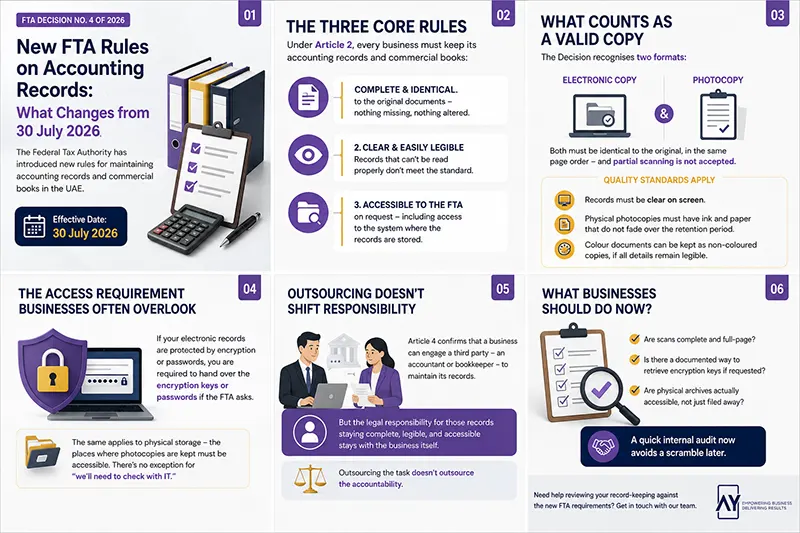
The Federal Tax Authority has issued Decision No. 4 of 2026, setting out new rules and requirements for maintaining accounting records and commercial books in the UAE. The Decision takes effect on 30 July 2026, and every business — mainland or free zone — should understand what it means for day-to-day record-keeping.
The Three Core Rules
Under Article 2, every business must keep its accounting records and commercial books:
- Complete and identical to the original documents — nothing missing, nothing altered.
- Clear and easily legible — records that can’t be read properly don’t meet the standard.
- Accessible to the FTA on request — including access to the system where the records are stored.
What Counts as a Valid Copy
The Decision recognises two formats: an Electronic Copy and a Photocopy. Both must be identical to the original, in the same page order — and here’s the detail many businesses miss: partial scanning is not accepted. If you scan an invoice, the whole document goes in, not just the relevant page.
Quality standards apply too. Records must be clear on screen, and if you’re keeping physical photocopies, the ink and paper must not fade over the retention period. Colour documents can be kept as non-coloured copies, but only if all the details stay legible.
The Access Requirement Businesses Often Overlook
This is the clause worth flagging to every client: if your electronic records are protected by encryption or passwords, you’re required to hand over the encryption keys or passwords if the FTA asks. The same applies to physical storage —the places where photocopies are kept must be accessible. There’s no exception for “we’ll need to check with IT.”
Outsourcing Doesn’t Shift Responsibility
Article 4 confirms that a business can engage a third party — an accountant or bookkeeper — to maintain its records. But the legal responsibility for those records staying complete, legible, and accessible stays with the business itself. Outsourcing the task doesn’t outsource the accountability.
How AY Astute Group (AYCA) Can Help You Get Ready
Meeting these requirements isn’t just a compliance checkbox — it means genuinely testing whether your records would hold up if the FTA asked for them tomorrow. Our team helps businesses close that gap through:
- Record-keeping gap assessment — reviewing your current archiving policies and practices against Decision No. 4’s specific standards
- Document retrieval testing — pulling a sample of old invoices, contracts, and commercial books to check completeness and legibility
- Electronic records audit — verifying scans are full-page, storage systems are FTA-accessible, and encryption keys can be produced on request
- Physical archive review — checking photocopy quality and storage accessibility against retention-period requirements
- Third-party oversight support — helping you retain accountability where bookkeeping is outsourced, as Article 4 requires
- Remediation roadmap — a clear, prioritised action plan to close any gaps before 30 July 202
What Businesses Should Do Now?
With the effective date approaching, this is a good moment to review how records are stored: are scans complete and full-page? Is there a documented way to retrieve encryption keys if requested? Are physical archives actually accessible, not just filed away? A quick internal audit now avoids a scramble later.
FAQs — FTA Voluntary Disclosure in the UAE
Q1. What is an FTA voluntary disclosure in the UAE and when must businesses file one?
An FTA voluntary disclosure in the UAE allows businesses to self-report tax errors to the FTA before audit discovery. Businesses must file within 20 business days of identifying errors exceeding AED 10,000 in tax liability impact.
Q2. What penalties apply under the FTA voluntary disclosure in the UAE framework?
FTA voluntary disclosure in the UAE penalties apply at reduced rates — typically 5% of unpaid tax per month — compared to significantly higher penalties for errors discovered by the FTA during audit, making early voluntary disclosure strongly advisable for all businesses.
Q3. What errors trigger an FTA voluntary disclosure in the UAE obligations?
FTA voluntary disclosure in the UAE obligations arise from incorrect VAT return figures, wrong corporate tax calculations, misclassified supplies, omitted transactions, incorrect deduction claims, and any other errors that affect the tax liability previously reported to the FTA.
Q4. How does the FTA voluntary disclosure in the UAE process work in practice?
The FTA voluntary disclosure in the UAE process involves completing the FTA’s online disclosure form, providing detailed error explanations, submitting corrected tax calculations, paying the additional tax liability due, and settling applicable reduced penalties within the prescribed timeframe.
Q5. Can AY Chartered Accountants help identify errors requiring FTA voluntary disclosure in the UAE?
Absolutely. AY Chartered Accountants conducts proactive tax health assessments that identify potential FTA voluntary disclosure obligations in the UAE before the FTA discovers them — significantly reducing your penalty exposure and protecting your business’s regulatory standing.